Strategy / AI / Investment / Decision Design
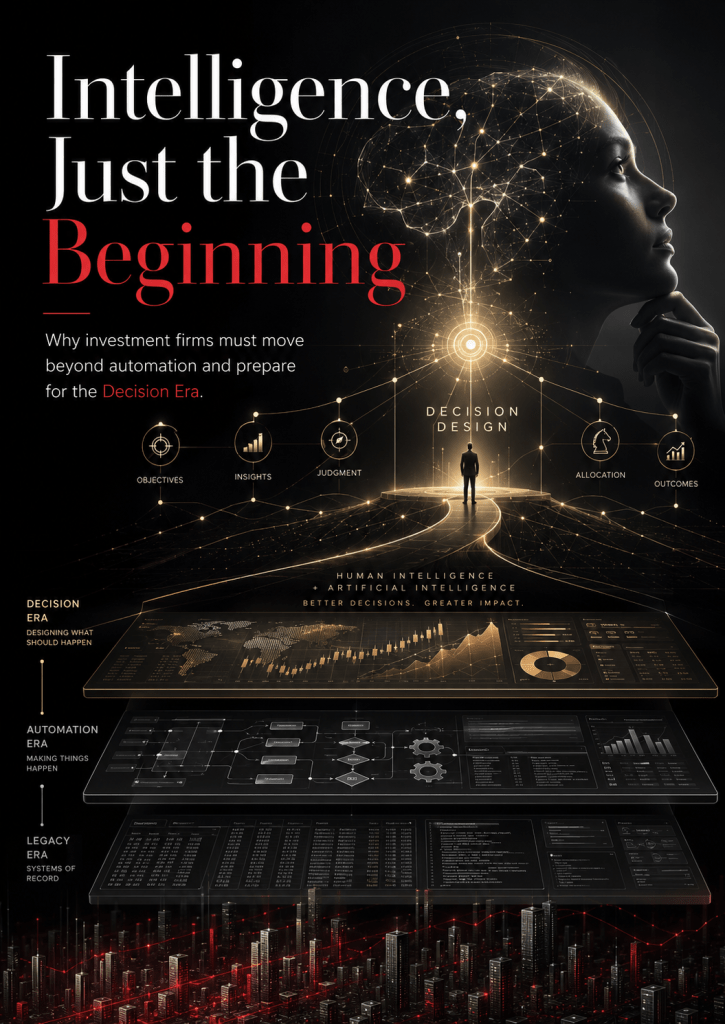
Intelligence, Just the Beginning
Why investment firms need to move beyond automation and prepare their portfolios for the Decision Era
For the last decade, technology investment has followed a reliable pattern: back companies that automate work, analyze data, detect risk, personalize experiences, monitor systems, and use artificial intelligence to help organizations move faster. The logic made sense because every industry was drowning in information and looking for tools that could turn complexity into speed, scale, and repeatable output.
That era produced valuable companies. It gave the market dashboards, alerts, recommendation engines, cybersecurity platforms, compliance tools, video intelligence systems, customer experience platforms, workflow automation, and AI-enabled infrastructure. But it also created a new challenge that many investment firms have not yet fully named. The world is becoming intelligence-rich and decision-poor.
Investment firms such as Wesley Clover now sit on portfolios filled with companies that generate intelligence. These companies help customers know what is happening. They surface anomalies, detect threats, personalize choices, organize data, capture feedback, monitor performance, and point users toward possible action. But in a market where every company can claim AI, intelligence is no longer the finish line. It is the starting point.
The next competitive question is not simply what AI can tell us. The better question is what decision a human, a team, a company, or a system should design because of what AI has revealed. That is where Decision Design Language becomes the missing layer.
The portfolio is bottom-heavy on automation
Most technology portfolios are strong at the lower layers of the intelligence stack. They are built around data capture, data movement, pattern recognition, alert generation, monitoring, workflow routing, personalization, reporting, and process automation. These capabilities are important, and they are not going away. They are the foundation of modern software and AI-enabled business.
The issue is that the foundation is becoming crowded. When every SaaS platform adds AI features, every dashboard gets smarter, and every workflow claims automation, the market begins to move the competition upward. Customers no longer ask only whether a system can produce more intelligence. They ask whether that intelligence helps them make a better decision.
Automation density asks how much the system can do. Decision depth asks how much better the customer decides because of the system.
The first question belongs to the Automation Era. The second belongs to the Decision Era. Companies that only increase automation density may become easier to copy. Their features can be replicated. Their models can be matched. Their dashboards can be redesigned. But companies that become embedded in how customers think, act, respond, and improve become more defensible.
That is why Decision Design Language is not a soft concept. It is a strategic moat. It gives technology companies a way to move from producing information to improving judgment. It changes the product from a tool the customer uses into a thinking environment the customer depends on.
AI is powerful, but it is not the major role
AI is one of the most important technologies of our time, but investors need to be careful not to mistake the engine for the whole vehicle. AI can generate, summarize, classify, detect, predict, recommend, simulate, and automate. It can increase the speed and scale of intelligence. But the human world does not run on intelligence alone. It runs on decisions.
Founders make decisions. Boards make decisions. Customers make decisions. Doctors and patients make decisions. Governments make decisions. Employees make decisions. Families make decisions. AI can influence all of them, but AI does not remove the need for judgment, context, timing, accountability, and human responsibility.
In many cases, AI increases the need for decision design because it multiplies options, signals, recommendations, predictions, and possible actions. A customer who once had too little information may now have too much. A manager who once waited for reports may now face constant alerts. A founder who once relied on instinct may now be surrounded by AI-generated advice. More intelligence does not automatically create better outcomes.
That is the paradox of AI. The more intelligence we create, the more decision structure we need. The firms that understand this early will not only invest in better AI. They will invest in the layer that helps people decide what to do with AI.
The next interface is cognitive
For years, the word interface meant screens, buttons, dashboards, menus, forms, and workflows. The interface connected people to software. It helped users click, search, filter, approve, reject, escalate, and complete tasks. That interface still matters, but it is no longer enough.
In the Decision Era, the next interface is cognitive. It is the structure that connects intelligence to judgment. It is the language that helps a person pause, frame the situation, ask better questions, absorb context, access relevant signals, activate a response, attune to feedback, and play with better options before rushing into action.
That is the role of a Decision Design Language. It gives users a repeatable way to structure their thinking with AI. It turns AI from a tool that answers into a partner that helps design. It creates the conditions for co-cognition, where humans and AI think alongside one another through a shared decision structure.
This is where two-5-two becomes strategically important. It does not compete with AI platforms. It gives them a missing layer. It does not replace automation. It makes automation more usable. It does not reduce intelligence. It organizes intelligence around better human action.
Why Wesley Clover should pay attention
Wesley Clover’s portfolio is a strong example of where this shift matters. Many of its companies already live in the world of intelligence, automation, data, governance, cybersecurity, customer experience, commerce, health, infrastructure, learning, and transformation. They help customers see more, monitor more, detect more, personalize more, comply more, and respond faster.
But every one of those outputs eventually reaches a human decision point. A video intelligence platform may detect an anomaly, but someone still has to decide whether it is urgent, routine, accidental, or strategic. A cybersecurity platform may identify a threat, but the organization must decide how to respond. A compliance tool may surface risk, but leaders must decide how to act in a way that is timely, proportionate, and defensible.
A customer experience platform may capture dissatisfaction, but the company must decide whether to change the product, retrain the team, redesign the journey, or adjust the promise. An e-commerce platform may recommend a product, but the customer is still making a decision about need, value, timing, trust, and identity. A healthcare platform may produce a signal, but the clinician still carries the responsibility of judgment.
This is why intelligence is only the beginning. The real value begins when intelligence becomes a designed decision. For Wesley Clover, that means the next portfolio advantage may not come from adding more AI to every company. It may come from helping each company understand where its intelligence becomes a decision, and then designing that moment better than competitors can.
Most software was built to execute decisions. The next generation will design them.
For investment managers, this is the uncomfortable truth hiding underneath the AI boom: much of the software built over the last twenty years was designed to execute decisions that had already been made. A user fills a form. A rule is triggered. A workflow advances. A dashboard reports. A recommendation appears. A task is completed. The software may be efficient, but the decision itself has already been flattened into a predetermined path.
That was acceptable when software lived mainly in the world of repeatable tasks. It is less acceptable now that AI is moving into decisions involving uncertainty, emotion, context, timing, trade-offs, ethics, and human consequence. Most applications were built to process decisions as if they were static. Real decisions are not static. They unfold. They change as people learn. They shift as new signals appear. They deepen as consequences become clearer.
This is not a slow drift. It is a structural incompatibility. Applications built on static, predetermined logic simply cannot hold the kind of complexity that real human decisions involve, and that AI, guided by two-5-two, is now capable of navigating. The software industry is approaching a turning point where the old interface will not disappear immediately, but it will begin to look increasingly incomplete.
The next generation of software will not simply help users execute decisions. It will help users design them. That means products must move beyond forms, rules, alerts, dashboards, workflows, and recommendations into decision environments where human intelligence and artificial intelligence can think alongside one another.
Where old software assumptions become outdated
Healthcare: rule-based care paths become insufficient
In healthcare, many systems are still built around diagnostic trees, codified pathways, and predefined care protocols. These tools can be useful, but they often struggle to hold the living complexity of a patient whose symptoms are evolving, whose history is incomplete, whose emotions matter, and whose care decision carries real human consequence.
A Decision Design Language layer would not replace clinical expertise. It would help clinicians, patients, and care teams hold the full decision more honestly. Instead of forcing a living patient into a rigid pathway, the system could support Pause, Ask, Absorb, Access, Activate, and Attune as the care decision evolves. That is a different kind of healthcare software. It does not only process the case. It helps design the care decision.
Strategy: annual planning gives way to continuous sensing
In strategy, many organizations still rely on annual plans, quarterly reviews, and performance dashboards that report what happened after the fact. This made sense when markets moved more slowly and intelligence arrived in batches. It makes less sense in a world where AI can continuously sense changes in customers, competitors, regulation, cost, talent, and technology.
The strategic software of the Decision Era will not simply report on last quarter. It will help leaders sense what is becoming possible. It will help teams distinguish between a passing signal and a meaningful shift. It will turn planning into a living decision system, where leaders do not only track progress against a fixed plan, but continuously redesign decisions as new reality appears.
Education: fixed curriculum becomes too narrow
In education, the old model assumes that learners can move through the same curriculum in roughly the same order, at roughly the same pace, toward roughly the same proof of understanding. That model may be administratively convenient, but it does not match how learning actually develops inside a person.
A student’s understanding is not a fixed container being filled. It is a living shape. It grows through curiosity, confusion, emotion, repetition, discovery, memory, and personal meaning. AI can personalize content, but personalization alone is not enough. The real opportunity is to help learners design their learning decisions: what to ask, what to absorb, what to access, what to try, how to attune, and when to play forward with new confidence.
Legal: technically correct can still be humanly wrong
Legal systems often depend on rules, categories, precedents, contracts, obligations, and codified processes. These are necessary. But complex legal decisions also involve context, intention, harm, fairness, uncertainty, power, and human circumstance. A system that applies rules deterministically can produce an outcome that is technically correct but humanly wrong.
Decision Design Language can help legal and compliance platforms become more context-aware without becoming arbitrary. It can give legal teams a structured way to examine the situation, the opportunity, the human consequence, the available signals, and the proportional response. This does not weaken law. It makes legal decision-making more accountable to the full reality it is meant to serve.
Products: imagined personas are no longer enough
For years, product teams designed user journeys around personas, funnels, conversion paths, and idealized customer behaviours. That helped companies simplify complexity, but it also created products that often serve imagined users better than actual humans in actual moments.
Real users arrive with shifting needs, competing priorities, hidden fears, emotional hesitation, incomplete information, and changing goals. A Decision Design layer allows products to respond to the decision the user is actually making, not just the journey the company imagined. This can move product design from persuasion to partnership, and from conversion optimization to decision optimization.
AI assistants: fast answers are already insufficient
AI assistants are impressive, but many still operate as fast-answer machines. They respond to the latest prompt, generate a useful output, and then wait for the next instruction. Even when memory is added, the deeper issue remains: the assistant often does not hold the becoming of the decision across the depth of a real human need.
This is where two-5-two changes the role of AI. A response is a snapshot. A decision is a becoming. When AI is guided by a Decision Design Language, it can stop treating every exchange as an isolated request and begin helping the user navigate the decision space. It can remember what was absorbed, what was accessed, what was activated, and what must now be attuned. That is the difference between an assistant and a co-cognition partner.
Three portfolio products that could advance through Decision Design
To see the opportunity clearly, investment managers do not need a theory exercise. They can begin with three kinds of products already common inside intelligence-heavy portfolios: responsible AI platforms, video intelligence systems, and digital experience monitoring tools. Each can remain a strong product as it is. But each can also become more valuable by integrating two-5-two as a Decision Design Language layer.
1. Corpus AI: from responsible AI platform to responsible decision platform
Corpus AI is positioned as a responsible AI platform. That is timely because organizations are under pressure to use AI safely, ethically, and productively. But responsible AI cannot stop at model governance, output review, and policy alignment. The customer still needs a way to decide what to do with AI-generated insight.
A Decision Design roadmap for Corpus AI could add a two-5-two wrapper around AI outputs. Instead of presenting an answer as the final product, Corpus AI could guide users through Pause, Ask, Absorb, Access, Activate, and Attune. The system could help users identify the decision being made, the assumptions behind the AI output, the human context that must be absorbed, the risks to access, the next action to activate, and the feedback loop required to attune the decision.
This would move Corpus AI from responsible AI usage into responsible decision design. The product would no longer only help companies govern AI. It would help people use AI inside a visible, teachable, auditable decision process. That gives the platform a stronger enterprise story because risk leaders, legal teams, executives, and operators all need more than AI access. They need decision accountability.
2. Solink: from video intelligence to decision intelligence after the alert
Solink is mapped as a video intelligence and analytics company. Video AI can surface anomalies, patterns, suspicious activity, operational issues, and moments that need attention. That is valuable. But the alert is not the decision. The alert is the beginning of the decision.
A Decision Design roadmap for Solink could turn every major alert into a structured decision moment. When the system detects an issue, the interface could ask the operator to classify the situation, absorb relevant context, access nearby signals, decide whether the moment is routine or urgent, activate a proportionate response, and attune future thresholds based on what was learned.
This would make Solink more than a system that shows what happened. It would become a system that helps organizations improve how they respond. For retailers, restaurants, facilities, and security teams, that matters because bad decisions after accurate alerts still create cost, risk, and confusion. The roadmap opportunity is to own the full path from detection to judgment to action.
3. Martello: from digital experience monitoring to operational decision design
Martello is mapped as a digital experience monitoring company. Its value sits in helping organizations detect performance problems, monitor service quality, and understand when systems are not delivering the experience users expect. In high-pressure IT environments, that kind of visibility is important, but visibility does not automatically create the right response.
A Decision Design roadmap for Martello could bring two-5-two into IT operations triage. When performance degrades, the system could help teams pause before overreacting, ask what decision needs to be made, absorb business impact, access technical signals, activate the most appropriate response, and attune after resolution to improve the next incident cycle.
This would make Martello more valuable to enterprise customers because it would not only monitor digital experience. It would help teams design better operational decisions under pressure. That can reduce noise, align teams, improve escalation, and turn incident management into organizational learning.
The learn108.com/dynamic-programming connection
Learn108’s Dynamic Programming argument sharpens the case for two-5-two because it explains why decision design is not a fixed checklist. It is a living architecture. Two-5-Two is presented as a grammar of how decisions live, not simply as a process or framework. That distinction matters because decisions do not unfold like forms being completed. They unfold as changing relationships between what is real, what is possible, what is felt, what is known, and what is still becoming.
In traditional software, many applications were built on the assumption that complex problems can be broken into simple steps, decided in advance, and executed in order. That assumption works for predictable tasks, but it breaks down when the decision itself is evolving. A serious decision is not a static problem waiting for a fixed solution. It is a becoming. It changes as new information appears, as emotion shifts, as consequences become clearer, and as the person or organization learns what the decision is really asking.
This is where dynamic programming becomes a useful bridge. In computer science, dynamic programming solves complex problems by breaking them into sub-problems, learning from each one, storing what matters, and building toward an improved solution. In Learn108’s decision language, every micro-decision becomes a sub-problem. Pause and Play shape when to go deeper and when to move forward. Situation and Opportunity define what is real and what could be possible. Ask, Absorb, Access, Activate, and Attune become the available moves that help the decision learn as it unfolds.
For investment managers, this is the important point. Most AI software still behaves as if the user needs a faster answer. But high-value customers do not only need faster answers. They need a better way to hold the decision as it becomes. That is what two-5-two can provide. It gives AI a shared grammar for co-deciding, without taking the decision away from the human.
The future will not be about programming machines alone. It will be about dynamically programming the decision relationship between humans, AI, products, teams, and organizations.
What Terry Matthews should ask his investment managers
For Terry Matthews, the question is not whether the portfolio has enough intelligence. It likely does. The stronger question is whether the portfolio has enough decision design. That is the question he should put in front of every investment manager.
He should ask where, inside each company’s product, intelligence becomes a decision. He should ask where the customer pauses before acting, where the software helps the user frame the situation, and where the platform helps separate signal from noise. He should ask where AI supports human judgment rather than quietly replacing it.
Most important, he should ask whether the product creates better decision-makers or merely faster operators. That distinction could change how portfolio companies are evaluated, how product roadmaps are shaped, how founder coaching is delivered, and how enterprise customers understand the value of the technology.
The old portfolio questions still matter. Market size matters. Revenue growth matters. Product adoption matters. Margin, defensibility, team quality, and exit potential all matter. But in the Decision Era, they are not enough. Investment managers also need to identify the decision moment inside every product.
That is the moment when data becomes judgment. It is the moment when AI output becomes human action. It is the moment when a customer moves from seeing to choosing. If that moment is not designed, the product is leaving value on the table. If that moment is designed well, the product can move from being a tool to becoming a decision partner.
The portfolio question changes
Investment managers should begin asking a new set of questions across AI, data, automation, governance, security, commerce, health, and workforce companies. Where does the user pause? Where does the user frame the situation? Where does the user absorb context beyond the data? Where does the user access the right signals? Where does the user activate a measured response? Where does the user attune based on feedback?
These are not decorative product questions. They are strategic questions. A company that produces alerts but does not help customers decide what the alert means is incomplete. A company that generates recommendations but does not help customers understand the trade-offs is incomplete. A company that automates workflows but does not improve judgment is incomplete.
The next generation of portfolio value will come from companies that do not merely produce intelligence, but help users design decisions with it. This is why Decision Design Language should become an investment lens, not just a training concept.
Decision Literacy becomes the new business skill
Decision Literacy is the ability to understand how decisions are framed, designed, tested, revised, and improved. It is the human skill that makes AI useful without making humans dependent. It helps people know when to trust a signal, when to challenge a recommendation, when to slow down, when to experiment, and when to act.
In the same way digital literacy became necessary when computers entered everyday life, Decision Literacy becomes necessary when AI enters everyday judgment. The more AI spreads, the more valuable this skill becomes. When intelligence was scarce, access mattered. When automation was scarce, efficiency mattered. When AI becomes abundant, judgment matters.
Decision Literacy is not soft. It is strategic. It helps a founder decide what not to build. It helps a product team know which AI feature actually matters. It helps a sales team understand the customer’s real decision environment. It helps a board separate urgency from panic. It helps a manager use AI without surrendering accountability.
For investment firms, this should matter because Decision Literacy can improve the performance of portfolio companies. It can shape founder behavior, customer success, product design, enterprise sales, board governance, and AI adoption. It is not simply an educational idea. It is a business capability.
Co-cognition is the real opportunity
The word AI may be too small for what is coming. The larger opportunity is co-cognition. Co-cognition means humans and AI thinking alongside one another through a shared structure. The human brings purpose, context, emotion, ethics, lived experience, imagination, and responsibility. AI brings speed, memory, synthesis, simulation, and pattern recognition.
Without a shared decision structure, co-cognition becomes messy. The human prompts, the AI answers, the human reacts, and the AI generates more. The result can be speed without clarity. Companies may feel more productive while becoming less deliberate.
Decision Design Language changes that. It gives the human and AI a pattern to work through together. It turns the interaction into a designed decision journey. It helps both sides move through the situation, the opportunity, the options, the constraints, the experiments, and the feedback.
This is where two-5-two can give co-cognition a practical grammar. It gives users a way to work with AI without surrendering the decision. It allows intelligence to support judgment, rather than replace it.
What Wesley Clover can do first
Wesley Clover does not need to rebuild its portfolio around Decision Design. It can begin by adding Decision Design as a strategic lens across the companies it already supports. The first step is a portfolio Decision Design audit.
Which companies generate intelligence? Which companies trigger decisions? Which companies operate in high-stakes environments? Which companies depend on trust, compliance, care, security, customer experience, or human judgment? Which companies already have strong automation density but weak decision depth?
The second step is product interface review. Where can two-5-two be embedded into the product journey? Where can Pause, Ask, Absorb, Access, Activate, Attune, and Play become part of the user experience? Where can a dashboard become a decision environment? Where can an alert become a structured response? Where can an AI recommendation become co-cognition?
The third step is founder and team training. Portfolio companies need leaders who understand Decision Literacy. Product teams need to design for decision moments. Sales teams need to explain not only what the software does, but what kind of decisions it improves. Customer success teams need to help clients build better decision habits around the tool.
The fourth step is market positioning. A company that says it uses AI sounds like every other company. A company that says it helps people design better decisions with AI enters a stronger category. That category is more human, more strategic, and more defensible.
The new competitive standard
The Decision Era will change what strong technology companies look like. A strong company will not only answer questions. It will improve the quality of questioning. A strong company will not only automate action. It will improve the judgment behind action.
A strong company will not only produce dashboards. It will help users understand what the dashboard is asking them to decide. A strong company will not only personalize recommendations. It will help customers understand their own decision criteria. A strong company will not only use AI. It will help humans and AI think together.
This is the shift investment managers need to see early. By the time the market fully names it, the advantage may already belong to those who designed for it first.
The invitation
The best decisions of a person’s life deserve to be genuinely designed. That includes career decisions, health decisions, family decisions, business decisions, investment decisions, learning decisions, product decisions, and leadership decisions. These decisions should not be reduced to prompts, forms, dashboards, or quick answers. They deserve a language capable of holding their complexity.
two-5-two is not just a product. It is not merely an app. It is a design language that people can learn and use in personal and professional decisions. It is also the grammar that can make AI a genuine thinking partner rather than a fast answer machine. The advancement described here is not distant. It is already emerging. What is missing is the language to navigate it.
That language is two-5-two.
 learn108.press